Abstract
3D semantic field learning is crucial for applications like autonomous navigation, AR/VR, and robotics, where accurate comprehension of 3D scenes from limited viewpoints is essential. Existing methods struggle under sparse view conditions, relying on inefficient per-scene multi-view optimizations, which are impractical for many real-world tasks. To address this, we propose SLGaussian, a feed-forward method for constructing 3D semantic fields from sparse viewpoints, allowing direct inference of 3DGS-based scenes. By ensuring consistent SAM segmentations through video tracking and using low-dimensional indexing for high-dimensional CLIP features, SLGaussian efficiently embeds language information in 3D space, offering a robust solution for accurate 3D scene understanding under sparse view conditions. In experiments on two-view sparse 3D object querying and segmentation in the LERF and 3D-OVS datasets, SLGaussian outperforms existing methods in chosen IoU, Localization Accuracy, and mIoU. Moreover, our model achieves scene inference in under 30 seconds and open-vocabulary querying in just 0.011 seconds per query.
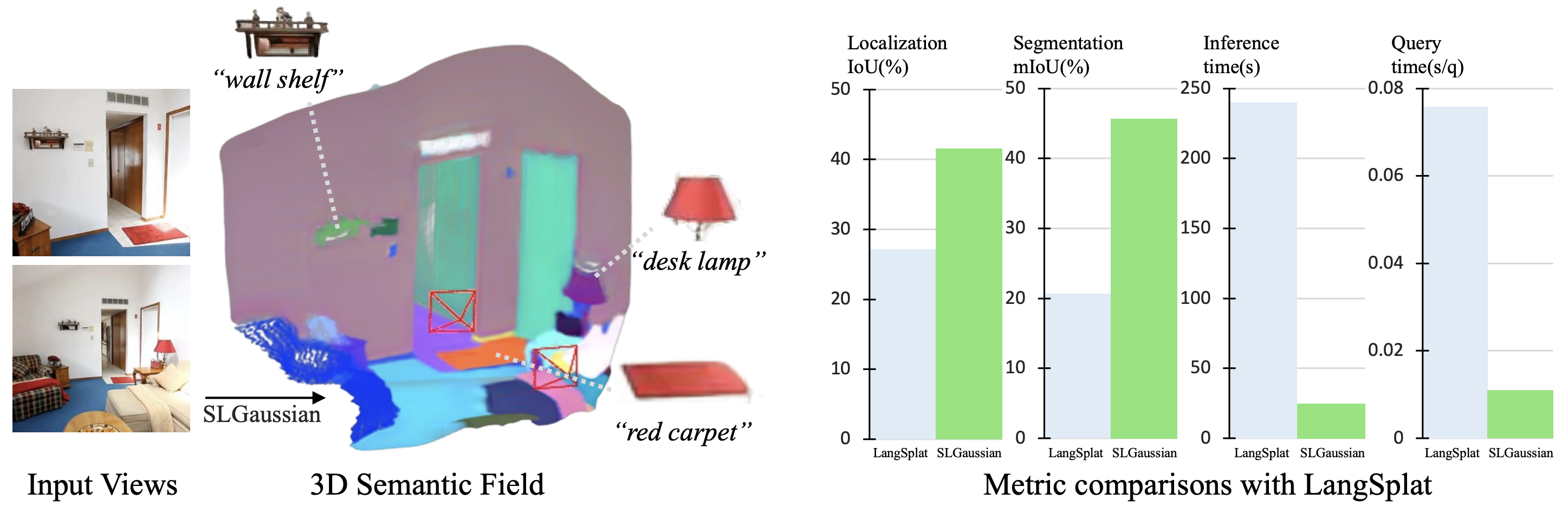
With just two RGB views, our method infers 3D semantic fields in under 30 seconds without per-scene optimization. On LERF and 3D-OVS datasets (image resolution 416 × 576), query time is 0.011 seconds/query, outperforming existing methods in both speed and IoU metrics.
3D semantic field video results on test scenes from the RealEstate10K dataset, using only two sparse-view RGB images as input.
Using our model pre-trained on the RealEstate10K dataset, we conducted inference on the LERF dataset scenes, using only two sparse-view RGB images — the first and last frames — as input.
Visual comparison on LERF and 3D-OVS datasets.
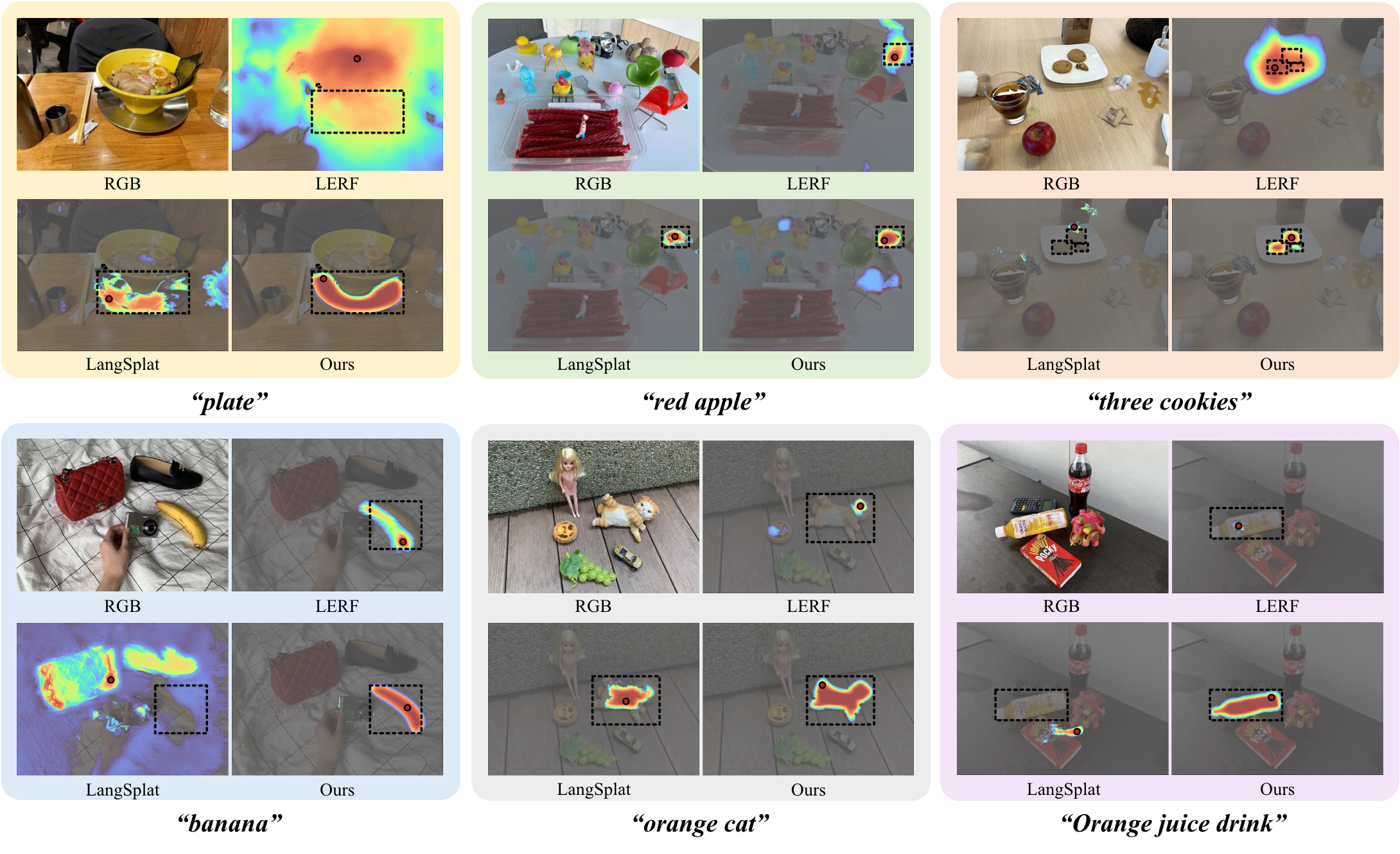
Qualitative comparisons of open-vocabulary 3D object localization on the LERF and 3D-OVS datasets. The top row displays scenes from the LERF dataset, while the bottom row shows scenes from the 3D-OVS dataset. Red points indicate the model predictions, and black dashed bounding boxes denote the annotations.